Enterprise AI Governance Needs a Foundational Strategy
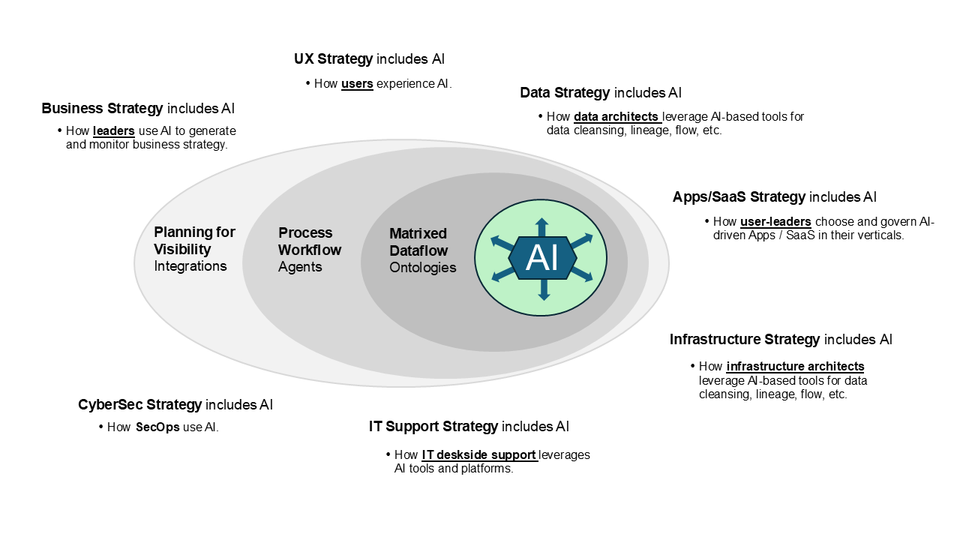
The diffusion of AI throughout the enterprise is happening with or without leadership's blessing. According to Deloitte's 2026 State of AI in the Enterprise, 88% of organizations are using AI in at least one business function; yet only 8% maintain a comprehensive governance framework. That gap represents both the strategic risk and the opportunity for enterprise leaders.
Enterprise leaders who take time to understand, embrace, evaluate and invest in AI are best equipped to manage its accelerating evolution.
Understand AI - The risk calculus has shifted.
AI risks are real: regulatory exposure, data privacy violations, model bias, and compounding technical debt from ungoverned deployments. The EU AI Act took full effect in August 2026, carrying fines up to 7% of global annual turnover. But the cost of inaction is equally real: efficiency losses, talent attrition, and competitive disadvantage. The NIST AI Risk Management Framework and ISO 42001 are now the reference architectures for U.S. enterprises. Enterprise leaders should frame AI governance not as a brake on innovation but as the infrastructure that makes innovation sustainable.
Embrace AI - Shadow AI is already inside the enterprise.
80% of organizations report moderate to pervasive shadow AI use across their workforce. 47% of generative AI users are still on personal, unmanaged tools. New hires don't see AI as optional; they see the absence of sanctioned tools as a reason to bring their own. Enterprise leaders must start from this reality: employees are already forming habits, building workflows, and making decisions with AI whether policies address it or not. Providing approved, governed alternatives is the only viable path to retaining control of the toolchain.
Continuously evaluate AI policy - Iteration beats perfection.
Policy deliberation should never become a barrier to use. Organizations losing ground aren't the ones with imperfect policies; they're the ones where the policy process itself became the bottleneck. Enterprise leaders should adopt a tiered risk model: low-risk use cases get lightweight fast-track approval; high-risk or regulated use cases get full review. AI policy should be treated as a living document with a defined review cadence; quarterly is a reasonable baseline; not a milestone to be achieved once. Governance-as-code and automated compliance checkpoints are emerging as scalable alternatives to manual review gates.
Invest in AI governance and organizational change management associated with AI - Governance and culture must move together.
A cross-functional AI steering committee - drawing from IT, legal, compliance, data science, and business units - needs a named executive owner with real decision authority, typically the CIO or COO. This body classifies risk, reviews deployment requests, monitors the AI portfolio, and reports to the board. But enterprise leaders should be clear-eyed about its limits: committees govern policy, not behavior. Only 26% of AI users say their leadership is clearly and consistently aligned on AI, and that alignment gap directly drives shadow AI. Organizational Change Management is now the highest-leverage investment in any AI strategy. Sustained enablement tactics - training, internal champions, transparent communication about what is approved and why - are efforts that close the gap between policy on paper and practice in the field.
Member discussion