AI Governance Policy Aligned with Digital Architecture is Synchronicity
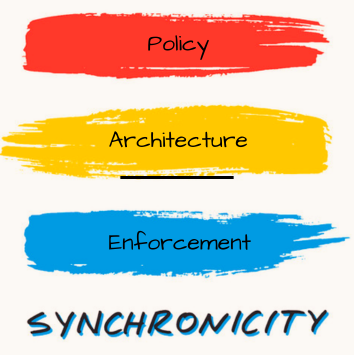
While listening this morning to the chorus of the title track of The Police’s blockbuster 1983 album Synchronicity, I started to think about the relationship between AI governance policy on paper and the critical need for organizations to govern AI architectures in production. The song speaks to an invisible thread holding disconnected things together. I think that is a fitting way to think about what's missing when AI policy and AI production architecture drift apart.
AI governance frameworks today measure whether the governance has been written down, not whether it can be enforced, or how. For example, a fully approved charter or risk taxonomy is great for the organization to have, but the documents won't automatically determine if a delivery team building an autonomous AI agent-based system is staying inside the lines that those AI governance-related documents require.
Enterprise AI activity is moving from understanding and selecting models to building autonomous, operating agents. Autonomous agents are risky precisely because they call tools, chain tasks, and touch production data with little human review. In this new world, governance isn't a document; it's whatever the digital architecture permits.
To understand the context within your organization, consider the following:
- Does your organization have a system of record for every AI use case in production?
- Can your organization trace a model's data lineage at any point?
- Is your agent access tied to enterprise identity management, in a zero trust context?
Today, most organizations find themselves maturing policy on paper but slow-walking changes to the digital architecture that can enforce those policies. There may be good (or bad) reasons for this disconnect. Maybe the slow walk is due to budget debates or organizational bureaucracies constraining timely architectural decisions. On the other hand, an organization might have decent technical controls but without enterprise guidance (i.e., standards) for how those controls should be configured.
Either combination fails the same way in production: the enterprise discovers the gap during an incident rather than a design review, which is exactly the failure mode governance programs exist to prevent.
The organizations that are doing AI governance right are the ones where policies are in sync with and can be traced to specific architectural controls. That synchronized traceability is the real measure of whether governance is operating or just a file on the shelf.
Next steps: crank up Synchronicity by the Police (it’s a classic), and then start to think about how your organization can build and/or configure autonomous capability to sync with the governance frameworks they intend to enforce, in real time.
Member discussion