AI Agents Are a Lot Like International Shipping Agents
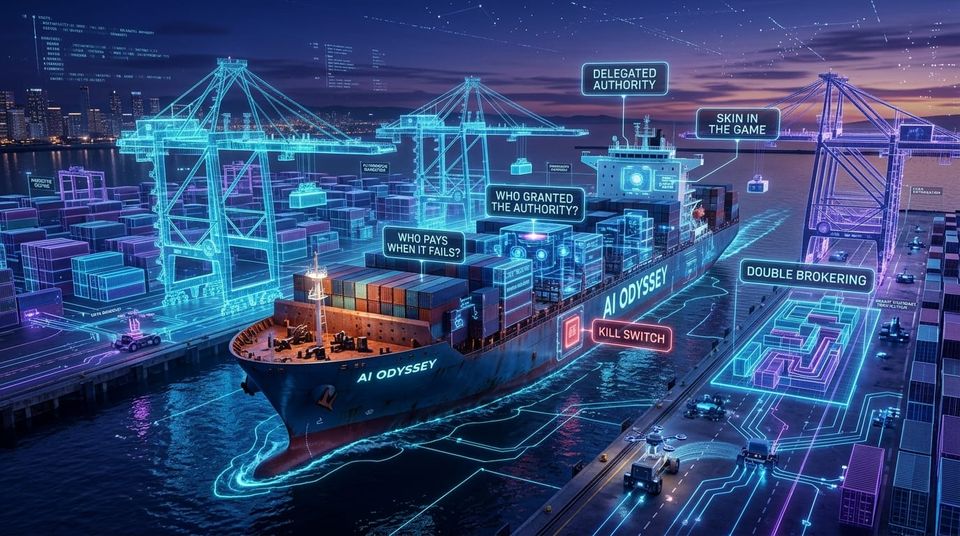
I took an international finance class in the 90's. Much of the class was focused on international shipping agents. I mean the living breathing humans that made distributed supply chains work.
In a pre-Internet supply chain, no company could hold every license, relationship, and local rule needed to move goods across borders. So they delegated to specialists called agents to move cargo. A customs broker clears the shipment. A freight forwarder books space for it on a ship. A port agent services the vessel when it arrives. Each one acts for someone else, with authority someone else granted.
Enterprises are doing the same with AI agents. AI agents act on our behalf, across systems we don't fully control.
The roles map closely, and so do the failures.
- Delegated-authority AI agent as customs broker. A broker needs a valid power of attorney before it can act as the client's agent. For AI agents, delegation works like an OAuth grant.
- Orchestrator AI agent as freight forwarder. A forwarder books carriers, coordinates handoffs, and sometimes issues its own paperwork. An orchestrator AI agent does the same and can even hire other AI agents.
- Embedded vendor AI agent as port agent. A port agent represents someone else's interests inside your operating environment. So do the AI agents bundled with your SaaS platforms.
- AI platform or API provider as carrier. A carrier holds your goods in custody, but statute and the bill of lading limit what it owes if something goes wrong. An AI provider's API holds your data and executes your AI agents' calls, and its terms limit what it owes in the same way.
Where each agent is vulnerable
The customs broker's vulnerability is authority that outlives its purpose. Regulators closed the broker delegation chain. Most enterprise agentic AI architectures haven't. Think of the over-scoped service account nobody revoked.
The freight forwarder's vulnerability is the handoff. Freight has a name for unauthorized sub-delegation: double brokering. A shipment gets reassigned without the shipper's knowledge or authorization. We've seen plenty of examples in the news recently of an AI orchestrator quietly handing a task to an AI agent that was never vetted.
The port agent's vulnerability is divided loyalty. It sits inside your environment but works for someone else. The mitigation for embedded AI is to understand, at a granular level, whose interests the AI agent serves and exactly when it diverges from your expectations.
The carrier's vulnerability is the liability cap. Under US ocean law the carrier's liability is capped at $500 per package, even when the carrier is plainly at fault. Many AI providers' terms work similarly. An AI agent that mishandles a $2M decision may leave you with a refund of a few months of platform license fees.
The risk mitigation shipping built, and what AI needs
Shipping layered its controls:
- Licensing: Brokers must file a supervision plan when they apply for a permit.
- Financial skin in the game: A licensed freight forwarder or non-vessel-operating common carrier (NVOCC) must post a surety bond. Lose the bond and the license is revoked.
- Paper trails: The bill of lading is the audit record.
- Verification: Identities are checked before the freight moves.
The AI equivalents are arriving: AI agent identity services, kill switches, sandboxed runtimes, and registries.
Here's how they line up, and where they fall short
Start with the customs broker's license. Before a broker can touch your cargo, it has to show how it will supervise its work. For AI agents, that means a governance policy and a registry of which AI agents exist and who owns them. Most of that is still vendor-specific.
Next comes verification. Shipping checks who you are before the freight forwarding happens. AI agent identity services, such as IBM Agent Identity and the Linux Foundation's Agent Name Service, are trying to do the same for AI agents. Both launched in recent weeks (as of November 2026). For the most part, each vendor still issues its own identities, and there is no shared licensing authority behind them.
Then there's the paper trail. A bill of lading records what moved, when, and who handled it. AI agent action logs play that role now. The catch is that the SaaS vendor may write its own receipt.
Containment is the strongest area. Sandboxes keep an AI agent in its lane, and kill switches, like CrowdStrike's, stop one that leaves it. A kill switch is only as good as the decision rights behind it: who may pull it, and when.
The biggest gap is skin in the game. Shipping has the surety bond. Lose the bond, lose the license. AI has no equivalent. Until it does, your governance has to supply one through contract terms, insurance, and a declared value for what each AI agent handles.
International shipping spent centuries building its paperwork. Your enterprise doesn't have that kind of time.
Member discussion